
Tips for Playing a Veteran Horse
As we celebrate our veteran horses this week, Cotswold player and Equine Physio Hayley Marsh gives us her top tips on keeping your older horse in great shape!
In our sport the older horse that is still sound and playing is well valued because generally they know the game so well, they are reliable and they can basically play the game for us. But as with humans, as you get older your body isn’t quite like it used to be, especially if they have had a life of polocrosse and even more so if they had a previous life in racing or polo or such like. That doesn’t mean we should throw them out to pasture, it means we just need to think a little more carefully about their fitness and management, for the extra it might take at home or off the pitch you will be repaid in the experience these guys can give you on the pitch.
So the big things to look for, check and do are as follow:
Warming Up
The biggest thing to do with any horse, especially the older horse, is a very good warm up and cool down. Make sure you take plenty of time to walk and get the horse supple and moving underneath you before you start any harder work. To do this they are best warmed up in a long and low posture and stretching down and out.
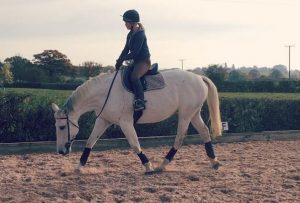
You need to make sure they are moving actively from behind but in their own comfort zone – the older horse can come out and feel very short and jittery, but if you give them the time to stretch down, lots of big circles and inside/outside bend, some gentle leg yielding/side pass, all with as low a head carriage as possible (without forcing !), in walk , trot and canter, they should start to move better across their back and joints and feel nicer to ride, at this point you can then start upping the work, before this point you are risking injury and a reduced performance.
Step It Up
So once warmed up, a great exercise for keeping a horse using itself correctly and getting the joints to use their full range of motion is pole work! It’s almost become ‘fashionable’ at the moment with it being all over social media, but my guess is that some people do not actually realise how beneficial it actually can be and how hard it is on the horse.
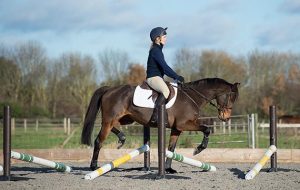
Pole work is good, because you can’t turn round to the horse’s back end and say “lift those legs higher, increase your stride length” but you can place them over poles that automatically make them lift their legs higher, stride out and hopefully then use their back, increase their core strength and become generally stronger in their bodies. Do not expect it all to be perfect, poles might end up being knocked and some horses might take a bit longer to understand than others but it is worth persevering for the results. You can do lots of different variations, scattered random poles, poles in a line, a maze, a square – let your imagination run wild!
KEY POINT
Walk is the best pace to do pole work in as there is no moment of suspension, so it is all muscular effort. You can then do work in trot and canter but ideally make walk work the priority.
Once your horse has it established you can then raise different ends of the poles to challenge them further, however remember with an older horse to listen to what they are telling you and go gently and slowly. The idea is that by raising the poles your increasing the range of movement needed and increasing the muscle building potential. It’s like adding weights at the gym, the key is to not jump the raised poles but to take them in your horses normal stride be it walk, trot or canter.
If you do not have schooling facilities these exercises can be tailored to do on a hack, you can do the long and low while hacking out (as long as it is safe of course) and you can find logs or sticks to walk over, walk in long grass, go up and down hills to try and simulate the pole work.
Also long and low and pole work are good exercises to do in-hand, long lining or lunging, there are also some good exercises you can do on the yard/field with your horses to help keep him supple and strong.
As with anything make sure your horse is warm before performing any of these and not straight out of the box on a freezing day
Stretching Exercises
Carrot stretches
Using a carrot, persuade the horse to bring his head down between his front legs. Encourage him to stretch as far as it is comfortable and hold the stretch for 10 seconds. Next, stand with your back to the horse’s shoulder and encourage him to bend his head and neck around you, ideally keeping his head vertical, and aim for the direction of the back fetlock. Aim for a smooth stretch — not a snatch — and hold for 10 seconds.
Fore-leg and hind-leg stretches
Pick up the horse’s foreleg and, with both hands on the fetlock, ease the leg forwards towards the horse’s nose and hold for 10 seconds. For the hind leg stretch, gently ease the hind leg forwards towards the foreleg and hold for 10 seconds. Start these exercises low to the ground then, as the horse becomes more supple to the movement, you can ask for more range.
Tail pulls
Stand at a 45 degree angle to the horses hindquarters and hold his tail, then gently pull on the tail and get him to rock towards you then gently let him return to standing square, then repeat this about 10 times on each side. You should see the horse’s quadricep muscles contract and in turn their abdominals should contract to stabilise them. This is equivalent to you doing squats – it helps strengthen muscles and increases their stability.
There are lots of different exercises to help with the older horse but these are just a snippet to hopefully aid you in getting started. Just always be mindful of each horse and look for any early warning signs that you may have increased the work too quickly.
Click here to check out more of Hayley’s exercises
Based in Gloucetershire, Hayley is a Veterinary Physiotherapist with a BSc in Equine Sports Science and a PgDip in Veterinary Physiotherapy. She is a member of the National Association of Veterinary Physiotherapists (NAVP), RAMP and is recognised and covered by Equine insurance companies.
You can find Hayley’s website at http://www.hayleymarshvetphysio.co.uk/